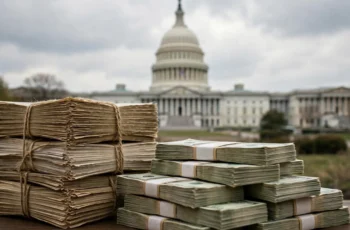
Almost every government owes money, and headlines about national debt often sound alarming. Yet government borrowing is a normal part of how countries finance themselves, quite different from a household running up a credit card. Understanding why governments borrow, who lends to them, and how the debt is repaid helps you read those headlines calmly.
The Basic Reason: Spending and Taxes Rarely Match
Governments spend throughout the year on salaries, services, and projects, while tax revenue arrives unevenly and often falls short. The gap between what a government spends and what it collects in a year is called the deficit, and borrowing fills it. Even well-run governments run deficits in most years, because matching spending and taxes exactly, month by month, would be impractical.
Borrowing Pays for Long-Term Investments
Much government borrowing funds things that benefit society for decades: roads, bridges, schools, and hospitals. It makes sense to spread the cost of a bridge across the generations who will use it, rather than charging today’s taxpayers the full price in one year, much like a household taking a mortgage.
Borrowing Also Smooths Out Economic Shocks
During recessions, wars, pandemics, or natural disasters, spending needs to rise at exactly the moment tax revenue falls. Borrowing lets governments support citizens and businesses through a crisis without raising taxes into a downturn, which would deepen it. This counter-cyclical role is a main reason economists accept government borrowing as a useful tool.
How Governments Actually Borrow: Bonds
Governments rarely take out bank loans. Instead, they issue bonds: formal promises to repay a set amount on a future date, with regular interest payments in between. Bonds are sold at auction to investors such as pension funds, insurers, banks, and ordinary savers. Because many governments have strong repayment records, their bonds are considered among the safest investments available.
Who Lends Governments the Money
The lenders are mostly domestic institutions and individuals. Pension funds hold government bonds to pay future retirees, insurers hold them to meet claims, and central banks hold them as part of managing the economy. Foreign investors hold a share too. In effect, a government’s debt is largely owed to its own citizens’ savings.
Interest Rates Decide How Expensive Borrowing Is
The true burden of government debt depends less on its size than on the interest rate paid on it. When rates are low, even a large debt can be serviced cheaply. When rates rise, interest payments consume a growing share of the budget, crowding out services or forcing higher taxes. Markets watch borrowing costs closely because they show how comfortable lenders feel.
How Repayment Usually Works: Rolling Over
Here is the part that surprises many people: governments rarely repay their total debt, and they are not expected to. When a bond matures, the government typically issues new bonds to repay the old ones, called rolling over the debt. What matters is keeping it manageable relative to the economy, so lenders stay confident.
The Role of Economic Growth
A growing economy makes debt easier to carry, because tax revenues rise and the debt shrinks relative to national income even if the amount owed stays the same. This is why economists focus on the debt-to-GDP ratio rather than the raw total, which can overwhelm a shrinking economy yet be sustainable in a growing one.
Inflation Quietly Changes the Picture
Moderate inflation reduces the real value of existing debt over time, because the government repays fixed amounts with money worth slightly less. This benefits borrowers at lenders’ expense, which is why investors demand higher rates when they expect inflation. Runaway inflation, however, destroys confidence and makes future borrowing far more expensive.
What Happens When Borrowing Goes Too Far
Borrowing becomes a problem when lenders doubt a government’s ability or willingness to pay. Interest rates spike, the currency may fall, and a debt crisis can follow. Painful choices come next: sharp spending cuts, tax rises, restructuring the debt, or seeking international help. The warning sign is rarely the debt level alone, but rising borrowing costs with weak growth.
How Governments Reduce Debt When They Choose To
Governments that decide to lower their debt burden have a few levers: running budget surpluses, growing the economy faster than the debt grows, or letting inflation erode its real value. Historically, most large debt reductions came mainly from growth and moderate inflation over many years, not dramatic surpluses.
Reading Debt Headlines With Perspective
National debt figures are quoted in trillions, which makes them sound catastrophic, but size alone tells you very little. Ask instead: what is the debt relative to the economy, what interest rate is being paid, and is the economy growing? A government borrowing cheaply to invest in a growing economy is in a fundamentally different position from one paying high rates to cover daily spending.